Be brave. It's the only way a team learns.

Carrying practice · Quadrant 2 · The flagship

Google studied 180 of its teams to find out what makes them effective. The single biggest factor wasn’t talent, dependability or clarity — it was psychological safety: the belief that you can speak up, disagree, admit a mistake or ask a naive question without being humiliated or punished. Teams that have it exceed their targets; teams that don’t miss them — Google’s own sales data showed a swing from +17% to −19%.
And yet most teams get it wrong, because psychological safety keeps being confused with being nice.

The six misconceptions

Amy Edmondson’s research keeps circling back to the same finding: leaders confuse psychological safety with agreeableness. We audit your team against the six most common misconceptions, organized on three axes:

Niceness vs. candor

Safety isn’t warm, conflict-free meetings — it’s healthy friction: pointing out mistakes and disagreeing openly, so information keeps flowing.

Comfort vs. accountability

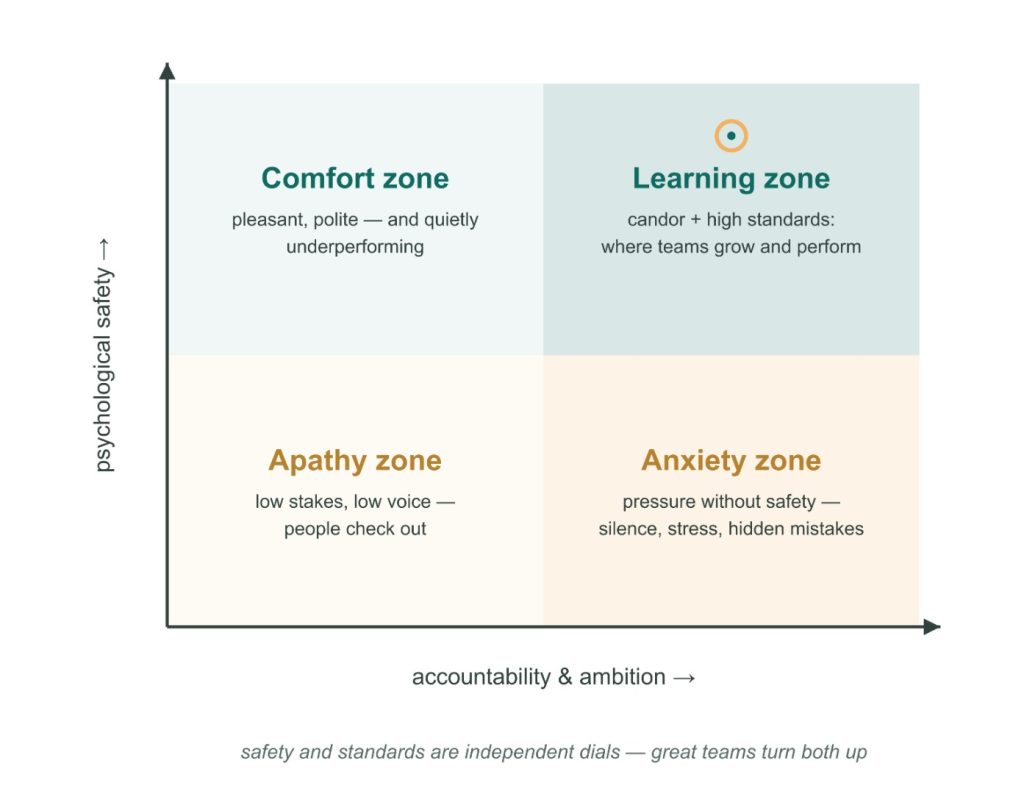
Safety and high standards are independent dimensions. Safety without standards breeds a comfortable, quietly underperforming team; standards without safety breed anxiety and silence. The goal is the learning zone: high on both.

Job security vs. performance

Safety doesn’t protect underperformance — it raises the performance ceiling, because problems surface early instead of late.

What we do

1 · Measure

Your team takes the survey: Edmondson’s validated 7-item psychological safety scale, an accountability subscale, and two items per misconception axis. Free, instant, nothing stored — start right on this page.

2 · Map

Your team’s position appears on the learning-zone map — anxiety, apathy, comfort or learning zone — plus a profile across all three axes. This is the psychological-safety subset of the full org map.

3 · Make sense

A facilitated workshop where team members compare individual results and name, often for the first time, what nobody was saying out loud.

4 · Train & coach

Leader training on the six misconceptions and a practical exercise library — framing work as learning, inviting dissent, responding productively to bad news — plus ongoing team coaching where it counts: in your real meetings, not a retreat bubble.

Take the free self-assessment

17 items, instant results — The Candor Compass. Leave your details and we’ll send your team the survey.

Formats & pricing

Free team self-assessment (on this page) · keynote “Candor over comfort” · half-day team workshop (EUR 3,000) · full-day survey + sensemaking + leadership training (EUR 5,000) · leader exercise program & licensable training content · team coaching engagements. Pairs naturally with Systemic Team Coaching for teams that want to keep going.

 
Amy Edmondson
Novartis Professor of Leadership and Management, Harvard Business School

“Testimonial pending — this is the page where it lands, beside the survey”

WHITEPAPER

False Harmony

Six ways teams mistake comfort for trust — and how to measure the difference.

Drafted, delivered as bebrave lab – Whitepaper – False Harmony.docx (5 pages, incl. the learning-zone map graphic). Serves as lead magnet on this page: download in exchange for an e-mail address.

The learning-zone map

REFERENCES