Purpose is not a poster. It's an operating principle.
Carrying practice · Quadrant 4
Most organizations have a purpose statement. Far fewer are purpose-driven — where purpose actually decides strategy, governance, investment and daily trade-offs. Purpose-driven organizations attract and keep better people, innovate by solving problems for business and society at once, and earn a trust no campaign can buy.
Why purpose, why now
Robert Quinn and Anjan Thakor put it plainly in Harvard Business Review: when an authentic higher purpose “permeates business strategy and decision-making, the personal good and the collective good become one” — people stop working for a pay-check and start working for meaning, and performance follows. The research base behind this keeps growing: purpose-driven firms show higher engagement, stronger retention, more innovation and greater resilience in crises.
But there’s a harder edge to it, and it matters: purpose that is only communication — purpose-washing — measurably backfires. Employees detect the gap between the poster and the P&L faster than any customer. That is why this practice is not about writing statements. It is about wiring purpose into the organization until the statement is simply true.
What purpose-driven actually means
We work along PAS 808:2022, the BSI’s publicly available specification for purpose-driven organizations — to our knowledge the first attempt to make “purpose-driven” auditable rather than aspirational. PAS 808 gives purpose work three things it usually lacks:

A worldview
Organizations are parts of interconnected social and ecological systems — the same nested picture our org map draws. A purpose that ignores the systems it lives in isn’t a purpose; it’s a slogan.
Principles
The organization exists to create optimal positive outcomes for people and planet; profit is how, not why. Long-term benefit outweighs short-term extraction; honesty about trade-offs outweighs image.
Behaviours
Governance that gives purpose the final word in decisions, strategy and investment aligned to it, transparent reporting against it — concrete, observable practices you can assess yourself against, today.
The purpose journey
1 · Locate
A purpose diagnostic against the PAS 808 principles and behaviours: where is purpose already alive in your organization, where is it decoration, where is it absent? Your position lands on the org map — because purpose sits in Quadrant 4, but its evidence sits everywhere.
2 · Define
We craft or sharpen the purpose with the people who must live it — not in a leadership offsite, but participatively. A purpose has to answer both directions at once: what does the world need from us (outside-in), and what are we uniquely built to give (inside-out)? The Japanese ikigai idea, applied to an organization.
3 · Embed
The step most purpose projects skip. We wire the purpose into governance, decision rights, incentives, the business model and daily rituals — following Quinn & Thakor’s playbook, from authentic leadership to letting purpose drive the trade-off conversations where it either lives or dies.
4 · Live & learn
Purpose is emergent, like strategy: it is not an annual review item. We build the rhythms that keep it honest — purpose check-ins in real decisions, stories that carry it, reporting that would embarrass you if it drifted.
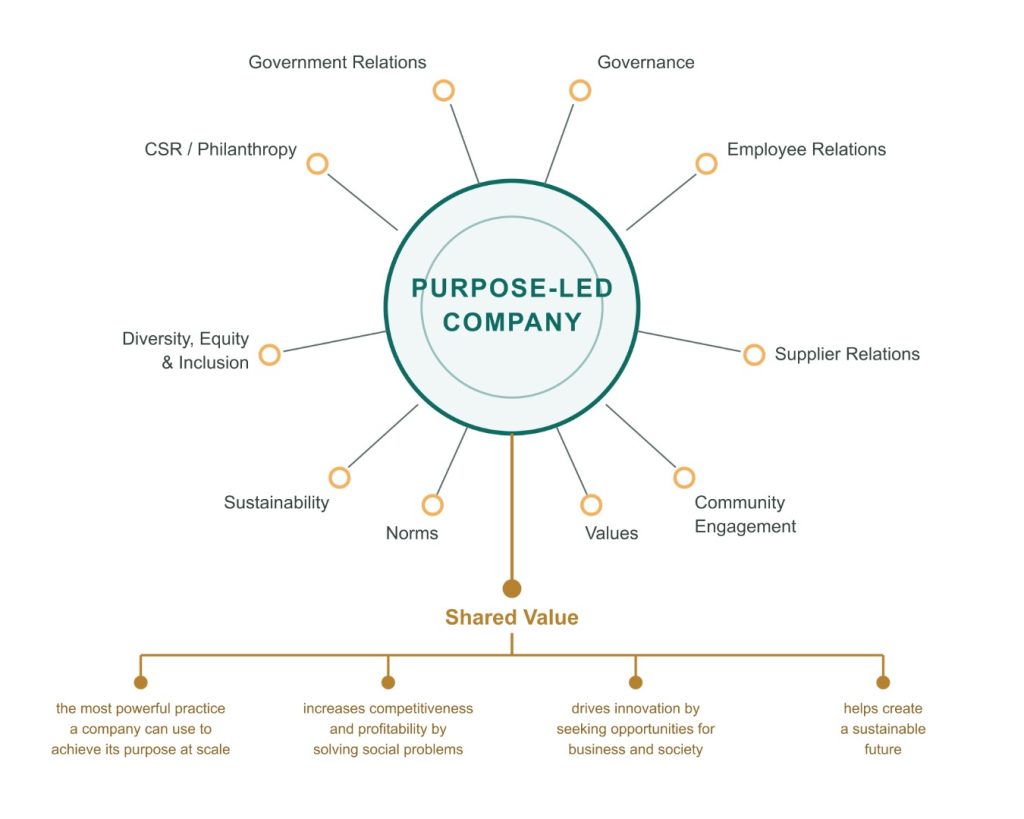
What a purpose-led company looks like
Formats
Keynote “From purpose statement to purpose-driven” · half-day purpose audit workshop · full-day purpose definition & embedding workshop · leadership training · whitepaper “The Poster Test: is your organization purpose-driven or purpose-decorated?”
The Poster Test
Is your organization purpose-driven or purpose-decorated?
Drafted, delivered as bebrave lab – Whitepaper – The Poster Test.docx.
- PAS 808:2022 (BSI)
- HBR's 10 Must Reads on Leading with Purpose — Quinn & Thakor, “Creating a Purpose-Driven Organization”
- Rey, Bastons & Sotok — Purpose-driven Organizations
- FSG / Shared Value Initiative — Purpose Playbook
- Ahrendt et al. — Organizational Ikigai
- Aziz — Good Is the New Cool: Guide to Personal Purpose
- Werte, Purpose und Vision
- Positive Psychology in Leadership