Organization Design
Every transformation starts with a map.
4 steps: Diagnose → Map → Make sense → Act, navigate & learn
Every transformation starts with a map.
You wouldn’t navigate new terrain without a map — yet most organizations attempt transformation without ever seeing themselves whole. The org diagnostic changes that. You have to be aware of your vertical and horizontal development level to confront your context.
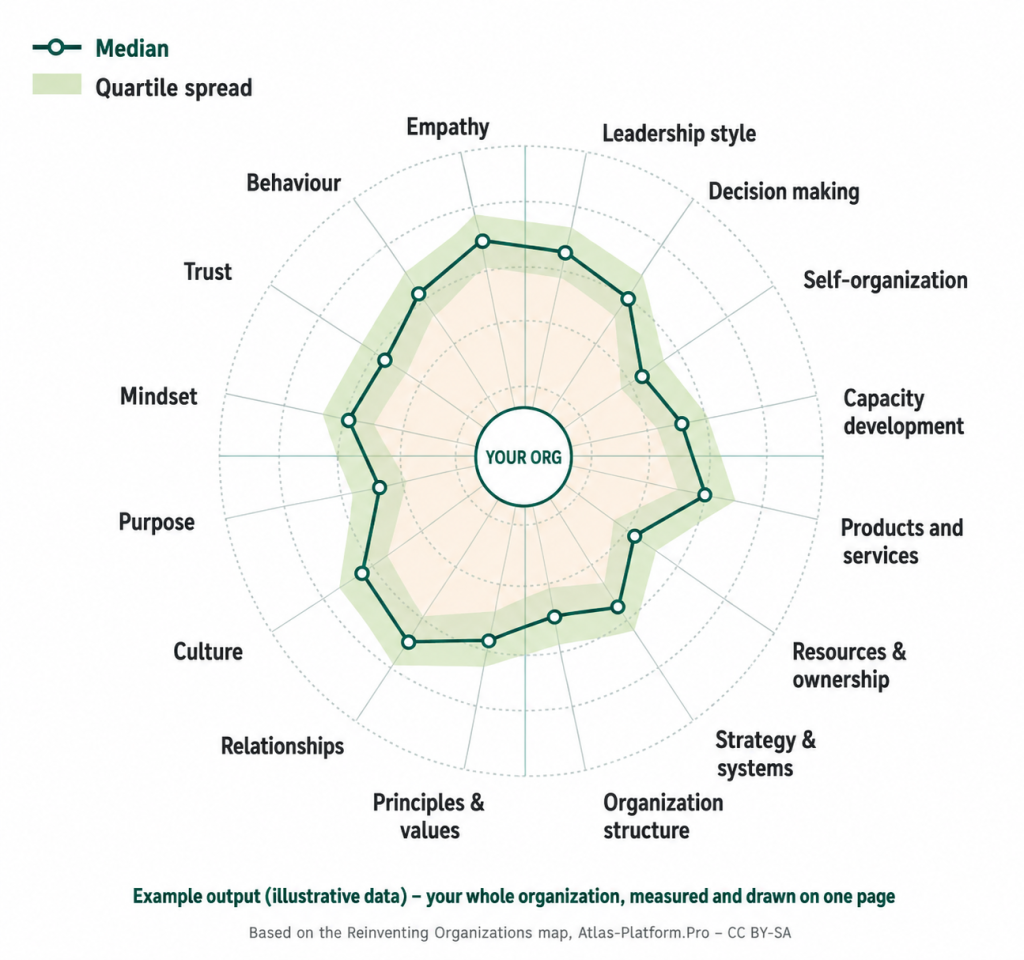
What happens: We run an organization-wide survey, a live mapping workshop, or both. The result is your visual org map: your organization’s current reality across four quadrants — mindset, leadership, structure and culture — on a single page. Then we bring it back to your people in a results workshop, where the room does the sensemaking.
What you leave with: a shared picture and awareness of where you are (and your strategy), an honest conversation you’ve probably postponed for years, and two or three design priorities your leadership team actually agrees on.
Formats: half-day mapping workshop · full-day diagnostic + sensemaking · organization-wide survey with facilitated results workshops. Ask for an offer.
Delivered with the Atlas Platform organization map — bebrave lab is an Atlas-certified practice.
Why the map matters

Most transformations don't fail at the solution. They fail at the diagnosis.
Initiatives get launched against symptoms — a reorganization here, a culture program there — while the real causes sit unexamined somewhere else in the system. The org map reveals gaps, mismatches and the causal patterns behind why past transitions stalled, and shows the leverage points across all four quadrants where effort will actually compound.
Maturity matters as much as skill.
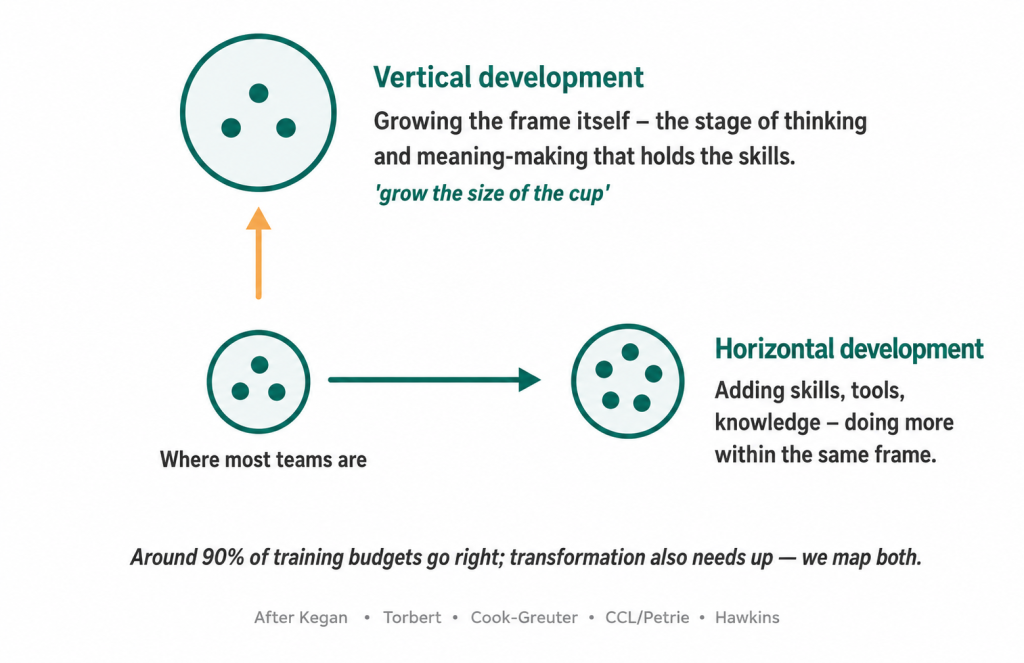
The map reads your organization on two axes of development: horizontal — the skills, tools and knowledge people have — and vertical — the stage of thinking and meaning-making they bring to complexity. Around 90% of training budgets go into the first; transformation usually turns on the second.
How we work with it
A systems approach — first see yourselves whole, name your context and its boundaries. Then we co-create: with intuition, systems exploration and strategic foresight; experimenting iteratively; aligning structure with the change as it happens.
What the map opens up
It makes culture visible — and from there, whatever your organization is ready for: systemic design of strategy, business model innovation, understanding skill levels and learning needs, assessing your readiness for AI adoption, co-design across teams and stakeholders, and maturing toward regeneration and self-organization.
What changes in the room
A holistic assessment of culture, leadership, collaboration and systems; a visual “aha” for decision-makers; survey results visualized in real time. Transformation stops being a project and becomes a journey.
A word of caution, offered honestly: the map is not the territory. This is holistic, systemic work — it improves your odds profoundly; it guarantees nothing.
And once you can see yourselves, the map has a second use: look forward. Draw the version of the organization you want to become, then back-cast — working backwards from that future to strategize the wisest path toward it.
Two axes of maturity
What you receive
The Psychological Safety Map
Psychological safety isn’t niceness. It’s the courage to tell the truth.
Most teams misdiagnose psychological safety as comfort, agreement or job security — and end up with false harmony instead of trust. We audit the six most common misconceptions, measure your team with Amy Edmondson’s validated 7-item scale plus an accountability subscale, and locate you on the learning-zone map: anxiety, apathy, comfort — or learning.
What happens: team self-assessment survey → your position on the safety × accountability map → a facilitated workshop where the team compares individual results → a practical exercise library your leaders keep.
Curious where your team stands? Get in touch if you would like to take the free team self-assessment — 17 items, instant results (The Candor Compass).
“Testimonial pending — reference placeholder for this offering”
“Testimonial pending — reference placeholder for this offering”
The Regenerative Business Model Map
Your business model on one canvas — social, environmental and financial value together.
The Flourishing Business Canvas extends business model thinking beyond profit: one visual canvas that lets you design how your organization creates financial viability, social benefit and environmental regeneration at the same time.
What happens: we map your current business model on the canvas with your team, stress-test it against the futures you actually expect, and design the next iteration — sustainable, circular, or regenerative.
bebrave lab was certified in the first wave of Flourishing Business Canvas Train-the-Trainers; Bernd Herbert chairs the Board of the Flourishing Business Co-Lab, the global home of the canvas.
The Regenerative Organization Map
Design an organization the world is better off for having.
Regeneration is where the two maps meet: the full org map (how you’re organized) plus the regenerative business model canvas (how you create value) — redesigned together so that your organization gives back more than it takes: to its people, its communities, and the living systems it depends on.
What happens: full org diagnostic → flourishing business model mapping → a design journey, in cycles, from “less harm” to “net contribution.” This is the deepest engagement we offer, and it usually starts with one workshop.

Start with a map
A half-day mapping workshop is the fastest way to see your organization whole.
- Atlas Platform — organization mapping methodology
- Flourishing Business Canvas — Flourishing Business Co-Lab